
Player Code of Conduct
Player Code of Conduct

MCKINNEY ICE HOCKEY CLUB PLAYER CODE OF CONDUCT
As a player representing McKinney Ice Hockey Club (MIHC), you are expected to uphold the values of USA Hockey by demonstrating integrity, respect, and accountability in everything you do on the ice, in the locker room, online, at school, and in the community. This Player Code of Conduct is grounded in USA Hockey’s Codes of Conduct, the Declaration of Player Safety, Fair Play & Respect, and USA Hockey’s stated zero‑tolerance stance on abuse, discrimination, and unsafe behavior.
This policy applies to all MIHC players at all times, whether on or off the ice, whenever their conduct may reasonably be understood to reflect on, involve, or represent McKinney Ice Hockey Club. This includes, but is not limited to, games, practices, workouts, team or club events, travel, use of locker rooms and facilities, attendance at other hockey activities while identifying with MIHC, and any in‑person, public, or digital setting (including social media, group chats, and messaging platforms) where a player’s actions, statements, or images could be linked to MIHC. Each player understands and agrees that compliance with this policy is a condition of participation, and that violations may result in disciplinary action, up to and including suspension or removal from the Club, in accordance with MIHC and applicable governing‑body disciplinary procedures
1. Commitment to Fun and Growth
Hockey at MIHC should be fun, challenging, and focused on long‑term development, in line with USA Hockey’s American Development Model and culture of Player Safety, Fair Play & Respect.
- Play for enjoyment, development, and love of the game; when players are having fun and feel supported, they learn more, stay in the sport longer, and build better skills and character.
- Come prepared to work hard, be coachable, and put team goals ahead of individual stats, understanding that USA Hockey emphasizes effort, learning, and team culture over short‑term results or “win at all costs” thinking.
2. Team Culture and Sportsmanship
Team culture at MIHC follows USA Hockey’s Declaration of Player Safety, Fair Play & Respect and Zero Tolerance principles: compete hard, respect everyone, and uphold the integrity of the game.
- Be a supportive teammate—communicate positively, encourage others, and act selflessly on and off the ice, recognizing that effort, attitude, and how you treat others are as important as the scoreboard.
- Respect opponents, partners, coaches, parents, officials, and volunteers at all times; without them, there is no game, and USA Hockey expects all participants to demonstrate sportsmanship toward every person in the rink.
- Accept referee decisions without argument, gestures, or disrespect; USA Hockey’s Zero Tolerance Policy prohibits disputing calls or using profane or abusive language toward officials, and such conduct may result in penalties and additional discipline by MIHC.
- Practice humility in victory and grace in defeat. Celebrate with class, honor the handshake line, and remember that how you win or lose is a direct reflection of MIHC and USA Hockey’s values.
3. Respectful Behavior & Language
Players are expected to use respectful, inclusive, and encouraging language at all times, consistent with USA Hockey’s Declaration of Player Safety, Fair Play & Respect and Zero Tolerance Policy.
- Racial or ethnic slurs, anti‑LGBTQ+ remarks, sexist comments, or any other hateful, biased, or discriminatory language are expressly prohibited and treated as serious misconduct; USA Hockey classifies discriminatory or hateful language anywhere in the rink as conduct warranting the highest level of game penalty and possible further discipline.
- MIHC has zero tolerance for verbal abuse, name‑calling, taunting, or language meant to demean, humiliate, intimidate, or exclude any person or group; repeated or severe use of such language may also constitute emotional misconduct, bullying, or harassment under SafeSport guidance.
- Players must treat all individuals with dignity and respect, regardless of race, color, national origin, ethnicity, sex, gender identity, sexual orientation, religion, disability, age, or any other protected characteristic, in alignment with MIHC’s Non‑Discrimination Commitment and USA Hockey’s inclusion and player‑safety principles.
4. Prohibited Conduct and Dangerous Behavior
MIHC strictly prohibits any behaviors or actions that endanger the safety or well‑being of others or violate USA Hockey’s Safe Sport Program, including:
- Profanity, obscene gestures, or disrespectful language toward teammates, opponents, officials, coaches, volunteers, or spectators, on or off the ice.
- Hazing, bullying (verbal, physical, or cyber), threats, stalking, or harassment of any participant, regardless of where it occurs (locker room, school, online, team events, or non‑MIHC settings).
- Locker‑boxing, roughhousing, “body checking” teammates off the ice, or any form of physical intimidation, including in locker rooms, hallways, hotels, parking lots, or other team areas.
- Fighting or intentionally dangerous play, including attempts to injure, targeting the head, or conduct that clearly violates USA Hockey’s playing rules and safety standards.
- Possession, use, or distribution of drugs, alcohol, vaping devices, tobacco, or weapons at any MIHC‑related activity or facility, or arriving under the influence of such substances.
- Theft, vandalism, or destruction of property belonging to teammates, opponents, the Club, facilities, hotels, or transportation providers.
- Inappropriate behavior in digital spaces: including group chats, social media, gaming platforms, or messaging apps such as sexually explicit content, sharing locker room images, cyberbullying, threats, harassment, or any communication that violates USA Hockey SafeSport or MAAPP electronic‑communications standards.
- Any of the above may be treated as abuse or misconduct under USA Hockey’s Safe Sport Program and may result in club discipline, USA Hockey/TAHA action, SafeSport reporting obligations, and referral to law enforcement where required.
5. Locker Room & Team Environments
The locker room is a team space and must be safe, respectful, and inclusive.
- All players must respect privacy and modesty; no player may observe another player of a different gender while they dress or undress, and co‑ed teams must follow USA Hockey’s Co‑Ed Locker Room Policy, including arriving in appropriate base layers and using separate or staggered changing when needed.
- Players must be fully and appropriately dressed in base layers and ready for team meetings well before game time so that female and male athletes can participate equally in all pre‑ and post‑game discussions without being exposed or made uncomfortable.
- Absolutely no horseplay, hazing, pranks, bullying, intimidation, sexual comments, slurs, or deliberate exclusion will be tolerated in the locker room or changing areas; any such behavior may be treated as abuse, harassment, or misconduct under USA Hockey’s Safe Sport Program and MIHC’s Disciplinary Policy.
- The use of phones, cameras, or any device capable of recording (photo, video, or audio) in the locker room is strictly prohibited, except as expressly allowed by MIHC under USA Hockey’s SafeSport guidelines; creating, sharing, or posting images or recordings from the locker room is a serious violation that may result in suspension or removal from the Club.
- • Players must follow all MIHC locker room supervision policies, including listening to designated Locker Room Monitors, promptly reporting problems, and complying with MAAPP one‑on‑one and monitoring rules for locker rooms and changing areas.
6. Off-Ice Conduct & Representation
You represent MIHC not just at games but in the community, online, and in daily life.
- Off-ice conduct that violates USA Hockey, TAHA, SafeSport, or MIHC policies may result in club discipline, regardless of where it occurs (school, work, social events, online, or at non‑MIHC hockey activities) and regardless of which organization first receives or investigates the complaint.
- Any behavior on social media, in group chats, at school, on trips, or elsewhere that involves bullying, harassment, threats, discrimination, sexual content, abusive language, or other misconduct as defined by USA Hockey’s Safe Sport Program and the U.S. Center for SafeSport Code will be treated as a Player Code of Conduct and SafeSport violation.
- SafeSport‑related concerns about an MIHC player or family member must be reported in accordance with USA Hockey and SafeSport reporting rules, and MIHC may take its own disciplinary action based on SafeSport outcomes or other reliable information, even when the original complaint was made to another club, league, or organization.
- Players and families are expected to use social media and electronic communications (texts, group chats, Crossbar, etc.) in a way that is respectful, non‑abusive, and MAAPP‑compliant; violations including posts or messages that demean, target, or endanger others are subject to investigation and sanctions under MIHC’s Disciplinary Policy.
7. Enforcement and Disciplinary Action
Violations of this Player Code of Conduct may result in disciplinary action under MIHC’s Risk Management & Governance Framework and USA Hockey’s Codes of Conduct, taking into account the severity of the behavior, the player’s intent, the impact on others, and any prior history. MIHC’s disciplinary process and potential consequences are described in detail on the Club’s Violations & Discipline page at mckinneyicehockey.org (Disciplinary Committee Policy & Procedures) &
Potential consequences include, but are not limited to:
- Formal verbal or written warnings and documented behavior contracts.
- Removal from a practice, game, team event, or team function.
- Short‑ or long‑term suspension from participation in MIHC practices, games, events, or team activities.
- Permanent dismissal from the McKinney Ice Hockey Club and revocation of membership privileges where warranted by serious or repeated misconduct.
- Mandatory reporting and escalation to USA Hockey, TAHA, the AT&T High School Hockey League, the U.S. Center for SafeSport, school officials, or law enforcement, as required by USA Hockey Safe Sport policies and applicable law.
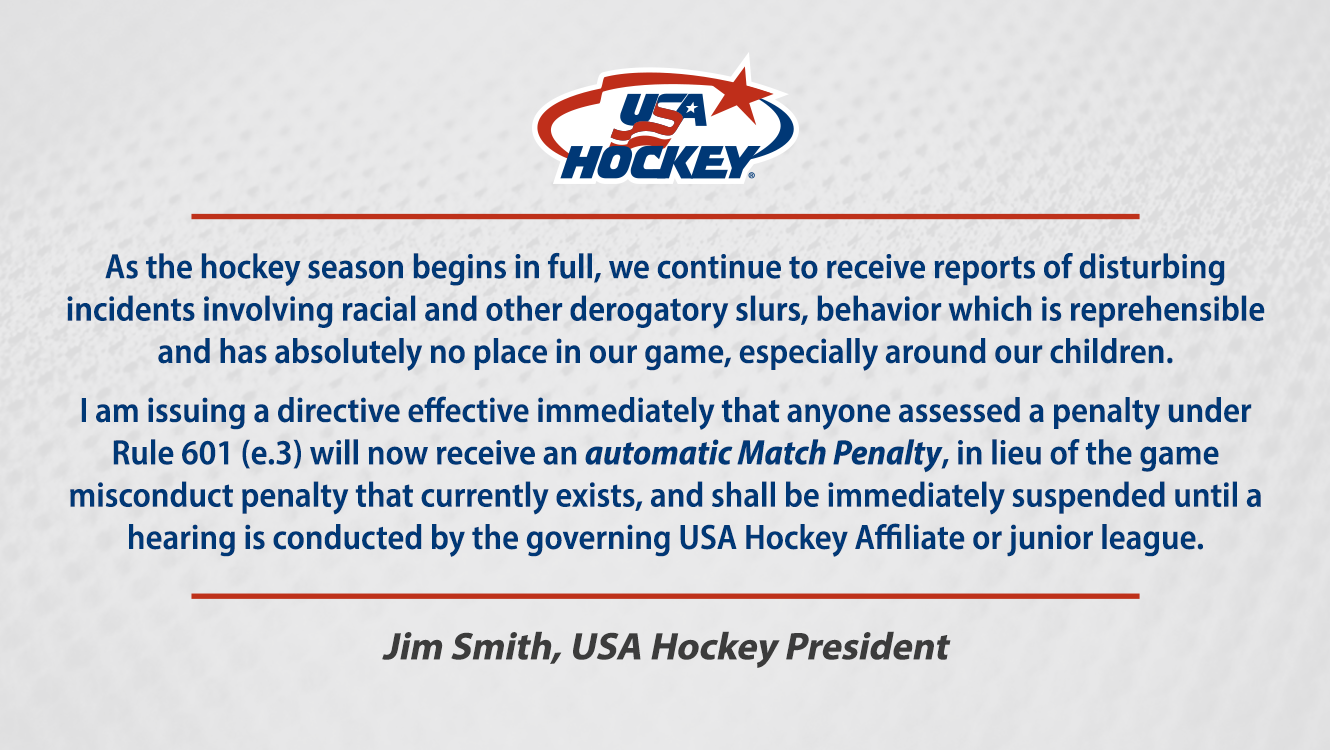
There is zero tolerance for racial, abusive, hateful, or discriminatory behavior in or around MIHC or any USA Hockey–sanctioned activity. Any use of racial or other derogatory slurs, discriminatory gestures, or conduct that is offensive, hateful, or targets a person or group based on race, color, national origin, religion, sex, gender identity, sexual orientation, disability, or any other protected characteristic is strictly prohibited and may result in an automatic match‑penalty‑level response on the ice and immediate club discipline off the ice.
Racial & Derogatory Slurs
There is zero tolerance for racial, abusive, or discriminatory behavior; violations may result in immediate suspension or expulsion.
Violations of this standard whether on the bench, in the locker room, in the stands, at school, or online may lead to immediate removal from the activity, interim suspension while the matter is reviewed, and, for serious or repeated offenses, expulsion from McKinney Ice Hockey Club and reporting to USA Hockey, TAHA, the U.S. Center for SafeSport, and/or law enforcement as appropriate.
Player Commitment
By participating in McKinney Ice Hockey Club, you agree to uphold this Code of Conduct and take responsibility for your actions. You are part of a team, a club, and a community; we expect you to protect the culture of mutual respect and integrity we all benefit from.
Disciplinary Enforcement and SafeSport Compliance Notice
The McKinney Ice Hockey Disciplinary Committee is authorized to review and enforce this Player Code of Conduct for all players, parents, coaches, volunteers, and other participants in the organization. All participants are subject to the rules, bylaws, and policies of USA Hockey, the Texas Amateur Hockey Association (TAHA), the AT&T High School Hockey League, McKinney Ice Hockey Club and the U.S. Center for SafeSport, including the USA Hockey Safe Sport Program. Any violation of this Code of Conduct, applicable league or governing body rules, or the SafeSport Code may result in disciplinary action up to and including temporary or indefinite suspension, missed practices or games, removal from team activities, and termination of membership in the McKinney Ice Hockey organization, in addition to any sanctions that may be imposed by USA Hockey, TAHA, the League, or the U.S. Center for SafeSport.
As a 501(c)(3) organization serving minor athletes, McKinney Ice Hockey and its Covered Individuals must comply with all applicable federal and Texas laws regarding the protection of minors, including mandatory reporting requirements for suspected child abuse, neglect, or misconduct. Nothing in this policy limits or replaces any individual’s obligation under federal or Texas law to report suspected abuse or neglect to law enforcement or child protective services, or to make required reports to the U.S. Center for SafeSport or other governing bodies. Where required by law or policy, suspected abuse or other serious misconduct involving minors will be promptly reported to law enforcement and/or appropriate government agencies, in addition to any internal or SafeSport-related reports.
Nothing in this disclaimer limits the independent authority of USA Hockey, TAHA, the AT&T High School Hockey League, or the U.S. Center for SafeSport to investigate, adjudicate, or sanction covered persons under their respective rules and disciplinary processes, which may operate separately from McKinney Ice Hockey’s internal disciplinary procedures.