

SafeSport
SafeSport Policies & Requirements

McKinney Ice Hockey Club SafeSport Policy
Effective August 2025
(Aligned to Current USA Hockey Policy)
The McKinney Ice Hockey Club (MIHC) is committed to providing a safe, positive, inclusive, and abuse-free environment for all participants—athletes, coaches, officials, volunteers, parents, and administrators. This SafeSport Policy reflects current requirements under the USA Hockey SafeSport Program and the U.S. Center for SafeSport Code.
Our goal is to eliminate all forms of abuse and misconduct and to ensure that everyone in our program is protected from emotional, physical, or sexual harm.
1. Scope and Definitions
This policy applies to all MIHC participants and aligns with the definitions and standards established by USA Hockey and the U.S. Center for SafeSport. Key definitions include:
- Abuse – Physical, emotional, or sexual mistreatment of a participant, including grooming, coercion, or exploitation.
- Harassment – Unwelcome behavior (verbal, physical, digital, or visual) that creates an intimidating, hostile, or offensive environment.
- Misconduct – Any violation of this or related USA Hockey policies, including bullying, hazing, retaliation, or inappropriate relationships.
- Retaliation – Any adverse action taken against a person for reporting misconduct or participating in an investigation.
- Mandatory Reporter – Any adult under USA Hockey governance who is legally and ethically required to report suspected child abuse or misconduct.
USA Hockey Safe Sport
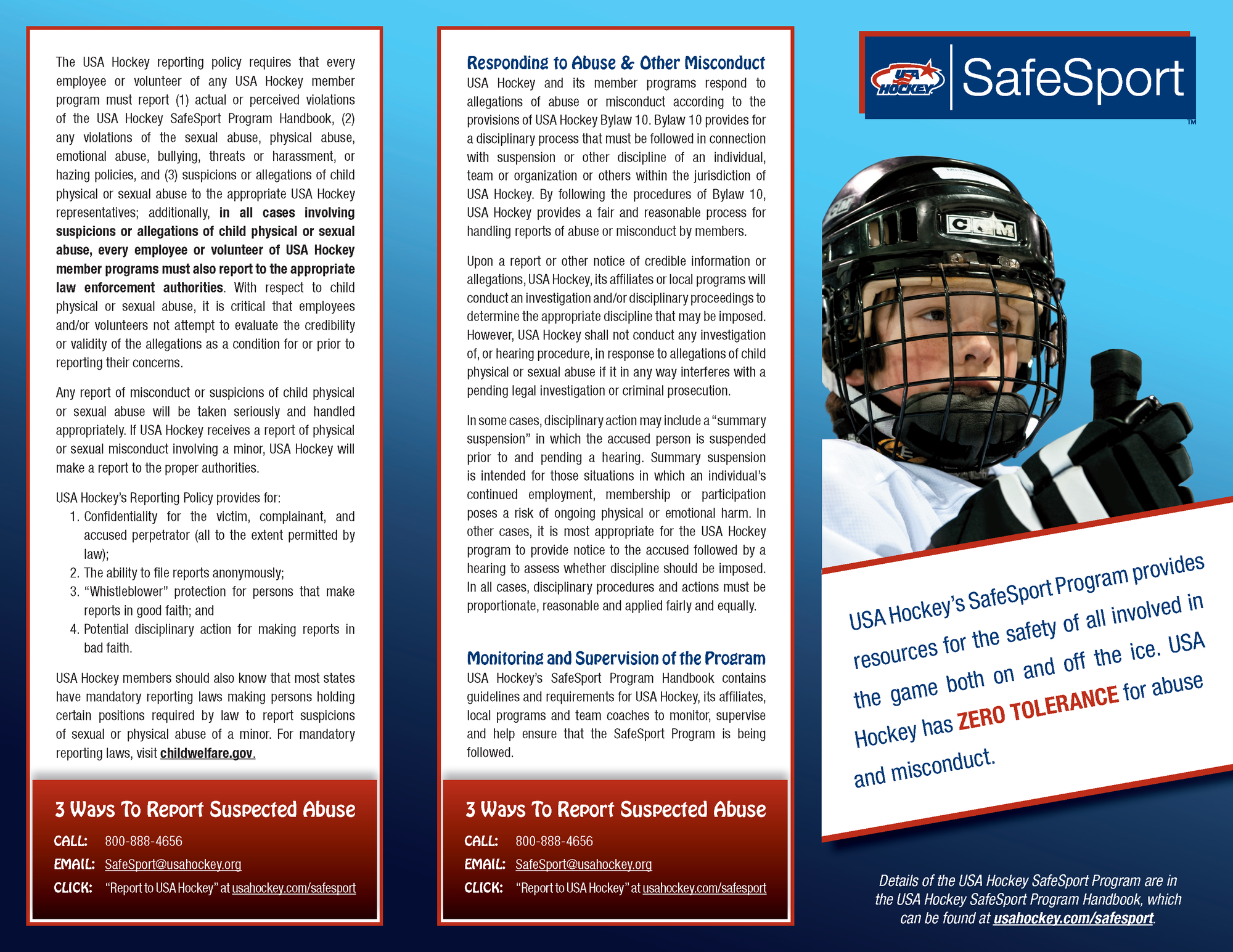
The safety of its participants is of paramount importance to USA Hockey. USA Hockey Safe Sport is the organization's program related to off-ice safety.
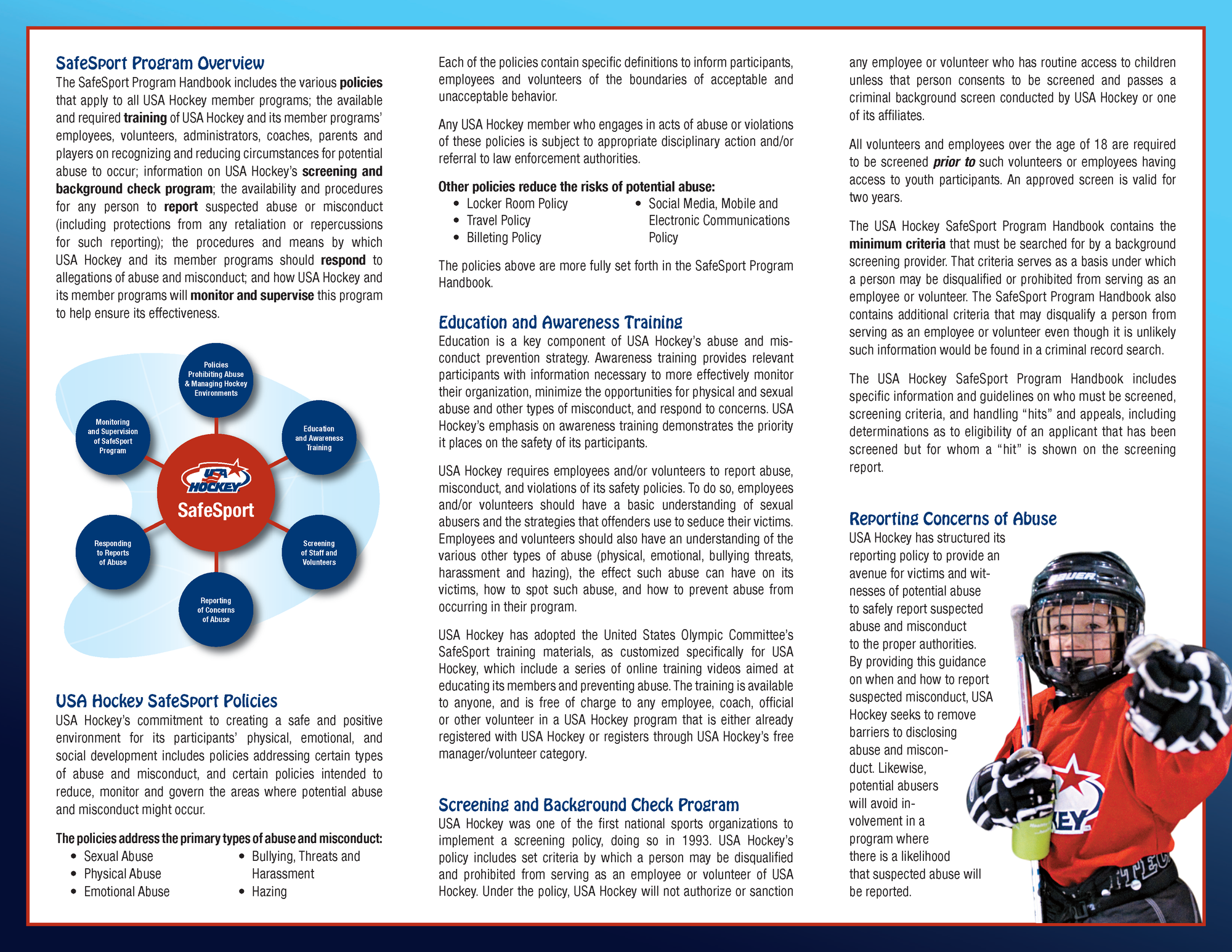
USA Hockey has long had systems in place to protect its participants from physical abuse, sexual abuse and other types of abuse and misconduct that can be harmful to youth hockey players and other participants. These include without limitation Physical Abuse, Sexual Abuse, Screening, Locker Room Supervision and Hazing Policies, in addition to Codes of Conduct applicable to administrators, coaches, officials, parents, players and spectators. The USA Hockey Safe Sport Handbook is intended to update and collect USA Hockey’s various policies to protect its participants from all types of misconduct and abuse.
2. Prohibited Conduct
In accordance with the SafeSport Code and USA Hockey guidelines, MIHC strictly prohibits the following behaviors under any circumstances:
- Sexual Misconduct – Sexual abuse, sexual harassment, or any unwelcome sexual interaction or behavior.
- Physical Misconduct – Non-accidental physical contact or attempts to cause bodily harm.
- Emotional Misconduct – Verbal threats, degrading remarks, persistent humiliation, or controlling behaviors.
- Bullying & Cyberbullying – Targeted, repeated aggressive behavior that causes harm or fear, including digital communications.
- Hazing – Acts that have the potential to humiliate, degrade, or injure, including so-called initiation “traditions.”
- Repeated Use of Racial, Ethnic, Religious, Gender-based, or Derogatory Slurs – Language or behaviors that demean, isolate, or target others based on personal identity or group membership. ➡️ There is zero tolerance for discriminatory or hateful speech of any kind.
- Inappropriate Use of Social Media or Digital Communication, including harassment or sharing explicit content.
3. Required Reporting Procedures
In accordance with federal law and USA Hockey policies:
- Anyone may report suspected abuse or misconduct. Reports can be submitted anonymously but must be made in good faith.
- All adults affiliated with MIHC are Mandatory Reporters and must report suspected child abuse or sexual misconduct to:
- The U.S. Center for SafeSport (for sexual misconduct and abuse)
- Law enforcement or child protective services (where applicable/required)
- USA Hockey SafeSport Program (for policy violations)
- MIHC SafeSport Coordinator (for local risk management)
No internal investigation should delay or replace the obligation to report. Retaliation against any person who makes a report is strictly prohibited and will result in immediate disciplinary action.
4. Investigation and Disciplinary Response
Upon receipt of a report, MIHC will follow the current USA Hockey Disciplinary Framework:
- MIHC will cooperate with the U.S. Center for SafeSport and/or law enforcement as applicable.
- Allegations not under SafeSport Center jurisdiction will be handled by USA Hockey or MIHC through a local disciplinary panel
Sanctions may include:
- Suspension from club activities
- Removal from coaching or volunteer roles
- Temporary or permanent playing bans
- Referral to law enforcement or other safe sport bodies
All investigations will be conducted fairly, promptly, and with full respect for privacy and due process.
5. Training & Education Requirements
To promote awareness and prevention:
- All coaches, officials, board members, team managers, locker room monitors, and volunteers who have regular contact with players must complete:
- U.S. Center for SafeSport’s Core Training annually
- USA Hockey’s background screening process
- Players turning 17 years or older must complete the SafeSport for Athletes course annually.
- Parents/guardians are strongly encouraged to review SafeSport resources available through USA Hockey.
Policy Review, Compliance & Enforcement
- MIHC’s Board of Directors will review this policy annually and update it as needed to comply with evolving SafeSport directives.
- Compliance with this policy is mandatory. Violations will result in disciplinary outcomes as determined by USA Hockey, SafeSport, or MIHC leadership.
Player and Parent Acknowledgment
All players and parents are expected to read, understand, and agree to comply with the MIHC SafeSport Policy as part of registration and participation. Ignorance of the policy is not a valid excuse.
Culture of Safety and Inclusion
McKinney Ice Hockey Club believes every participant has a right to compete and grow in a safe environment free of exclusion, abuse, or intimidation. By following the SafeSport framework, we protect the development, confidence, and mental health of every athlete in our program.
We thank all families, volunteers, and staff for their continued partnership in maintaining the highest standards of care and integrity throughout our hockey community.
USA HOCKEY, TAHA AND SAFESPORT INVESTIGATION CESSATION OF COMMUNICATIONS RULES:
If a SafeSport incident occurs and an individual is pending investigation or subject to suspension by the U.S. Center for SafeSport, USA Hockey, or the Texas Amateur Hockey Association (TAHA), it is the policy of the McKinney Ice Hockey Club that all non-essential communications between the suspended person and players, parents, staff, or other club members will cease immediately and remain suspended for the duration of the investigation and/or imposed restrictions. This includes but is not limited to phone calls, text messages, emails, direct messages, and social media communications, pursuant to the SafeSport Code, USA Hockey SafeSport Program, and TAHA SafeSport Policy .
This clause ensures compliance with national and affiliate governing body provisions stating that once the Center for SafeSport assumes jurisdiction or issues interim measures, Member Programs (including USA Hockey affiliates and local clubs) must honor and enforce those restrictions, including suspension of participation and related communication .
Supporting Policies:
- USA Hockey SafeSport Program: Requires adherence to all interim suspensions and prohibits additional club-level investigation or contact that could interfere with SafeSport proceedings .
- U.S. Center for SafeSport: Mandates cessation of contact and enforces restrictions during the Response & Resolution process, including when a temporary measure or safety plan is in place .
- Texas Amateur Hockey Association (TAHA): Adopts USA Hockey’s SafeSport and Communication policies, applying suspension and restriction measures as appropriate during investigations .
6. SAFE SPORT REFERRALS – RETURN-TO-PLAY EDUCATION
McKinney Ice Hockey Club (MIHC) encourages all players and families to take an active role in fostering a culture of safety, accountability, and respect consistent with USA Hockey and U.S. Center for SafeSport principles.
Any MIHC player who becomes the subject of a report, referral, or inquiry to the U.S. Center for SafeSport, USA Hockey SafeSport, TAHA, or any league‑ or facility‑based SafeSport process (including but not limited to the Dallas Stars Metroplex High School League (DSMHL), Allen Community Ice Leagues, the NYTEX Sports Centre, or the Texas Travel Hockey League) for alleged misconduct related to hockey participation or team‑related activities is strongly encouraged to complete additional SafeSport education and awareness training offered by the Club.
This recommendation applies regardless of whether any external SafeSport matter is ultimately substantiated, unsubstantiated, administratively dismissed, or closed for any reason. Participation in supplemental education reflects MIHC’s ongoing commitment to integrity, prevention, and community well‑being, not disciplinary action or presumption of wrongdoing.
MIHC’s approach aligns with guidance from USA Hockey and the U.S. Center for SafeSport, which encourages member organizations to promote voluntary education and prevention initiatives that strengthen understanding of SafeSport standards while respecting the Center’s jurisdiction and formal investigative processes.
6.1 Triggering Events
The following events trigger MIHC’s Return‑to‑Play Education Requirement:
- A written or electronic notification that an MIHC player has been referred to, or is under review by, the U.S. Center for SafeSport, USA Hockey SafeSport, TAHA, or any affiliated league/facility disciplinary or SafeSport process (including DSMHL, Allen Community Ice Leagues, the NYTEX Sports Centre, or the Texas Travel Hockey League) in connection with alleged misconduct occurring in, or reasonably related to, hockey participation or team‑related activity, whether the conduct occurred within MIHC, within a partner league, or on an outside team.
- A SafeSport/USA Hockey/TAHA notice indicating a case has been opened, reviewed, or administratively closed, even if no formal finding of a Code violation is made.
MIHC does not make or imply any independent finding of abuse or misconduct from the fact of referral alone. The education requirement is imposed to support prevention, awareness, and compliance for all participants.
6.2 Required Education for Athlete
Before the player may be reinstated to any MIHC on‑ice or team activity (including practices, games, team events, or team travel), the following may be required to be completed based on the jurisdiction of SafeSport and USA Hockey:
1. SafeSport Athlete Training (or equivalent):
- Completion of the U.S. Center for SafeSport / USA Hockey “SafeSport for Athletes” or age‑appropriate minor‑athlete education module, if eligible by age.
- If the athlete is below the minimum age for the standard athlete module, MIHC will assign an age‑appropriate SafeSport/MAAPP educational resource or video to be reviewed with a parent/guardian.
2. Acknowledgment of MAAPP and Club Policies:
- Athlete signs an updated MIHC Athlete Acknowledgment confirming understanding of:
- USA Hockey Safe Sport Program expectations.
- MAAPP one‑on‑one, electronic communication, and locker room standards.
- MIHC Player Code of Conduct.
3. Meeting with Coach and/or SafeSport Coordinator (Optional, if appropriate):
- A brief, observable and interruptible meeting with the athlete and at least one parent/guardian present may be held to review expectations and answer questions, consistent with MAAPP standards.
Documentation of completion is maintained by the MIHC SafeSport Coordinator.
6.3 Required Education for Parents / Guardians
Because parents/guardians have a key role in monitoring behavior and supporting compliance, reinstatement may also requires:
1. Parent/Guardian SafeSport Education:
- At least one or both parent(s) & or guardian(s) must complete one of the following - As directed by the MIHC Safety & Conduct Comittee:
- The free U.S. Center for SafeSport parent/guardian education module (where available).
- USA Hockey/club‑approved SafeSport/MAAPP parent training or webinar covering:
- Recognizing grooming and boundary‑crossing behaviors
- MAAPP rules on one‑on‑one, electronic communications, travel, and locker rooms
- Reporting obligations and retaliation prohibitions.
2. Parent Acknowledgment:
- Parent/guardian signs an updated MIHC Parent Acknowledgment stating:
- They have reviewed MIHC SafeSport Policies & Requirements.
- They understand USA Hockey, TAHA, and SafeSport expectations for conduct, reporting, and cooperation with any future investigations.
- They agree to support compliance with MAAPP and MIHC’s rink‑specific safety practices.
6.4 Relationship to USA Hockey, TAHA, and SafeSport Decisions
- No Conflict with SafeSport Jurisdiction: This education requirement does not alter, contradict, or extend any eligibility decision, temporary measure, suspension, or dismissal issued by the U.S. Center for SafeSport, USA Hockey, or TAHA. MIHC remains bound by all such determinations.
- Complementary Club‑Level Authority: USA Hockey’s Safe Sport Handbook and MAAPP direct “Member Programs” to implement required policies, education, and monitoring to reduce circumstances for abuse and to enforce MAAPP at the club level. TAHA SafeSport guidance similarly expects local associations to adopt and enforce policies that include training and curfew/monitoring requirements for participants and chaperones. The U.S. Center for SafeSport’s FAQs confirm that organizations may impose additional training requirements to meet their compliance standards, beyond the minimum SafeSport® Trained Core obligations.
Accordingly, MIHC’s Return‑to‑Play Education Requirement is a permissible, prevention‑oriented condition of club participation, applied uniformly to any athlete who has been the subject of a SafeSport/USA Hockey/TAHA referral, irrespective of outcome, and expressly subject to the superior authority of the U.S. Center for SafeSport, USA Hockey, and TAHA.
6.5 Documentation and Consistency
The MIHC SafeSport Coordinator will:
- Track which athletes and parents/guardians have completed required training and acknowledgments.
- Verify that all requirements are satisfied before a player appears on MIHC rosters, attends practices, or participates in games following a SafeSport referral.
- Ensure this section is applied consistently in all qualifying cases to avoid the appearance of retaliation or disparate treatment.
- Failure to complete the required education within a reasonable timeframe may result in continued ineligibility for MIHC participation, even if external eligibility has been restored, until all club‑level conditions are satisfied.
7. AUTOMATIC CLUB SUSPENSION UPON SAFESPORT / LEAGUE SUSPENSION
Any MIHC player who is suspended, restricted, or made ineligible by the U.S. Center for SafeSport, USA Hockey, TAHA, or any affiliated league or facility (including but not limited to the Dallas Stars Metroplex High School League (DSMHL), Allen Community Ice Leagues, the NYTEX Sports Centre, or the Texas Travel Hockey League) for an alleged SafeSport or Code‑of‑Conduct violation is automatically subject to the Return‑to‑Play Education provisions in Section 6 and to immediate club‑level suspension.
7.1 Automatic Suspension of MIHC Membership and Participation
Upon written or electronic notice that such a suspension, restriction, or temporary measure has been issued:
- The player’s membership and participation with MIHC is immediately suspended, including practices, games, team events, travel, and access to locker rooms or team communication channels, for as long as the external suspension or restriction remains in effect.
- MIHC will honor and enforce all interim measures, safety plans, and reinstatement conditions imposed by the U.S. Center for SafeSport, USA Hockey, TAHA, or the applicable league/facility, as required under the USA Hockey Safe Sport Program and TAHA SafeSport policies.
7.2 Additional MIHC Disciplinary Review
In addition to honoring external sanctions:
- MIHC may, at its discretion and consistent with USA Hockey and SafeSport guidance for Local Affiliated Organizations, initiate its own internal disciplinary review to determine whether club‑level sanctions (up to and including termination of membership) are warranted to protect minor athletes and manage organizational risk.
- Any such review will follow MIHC’s Disciplinary Policy and Hearing procedures and will not interfere with, or attempt to re‑litigate, the jurisdiction or findings of the U.S. Center for SafeSport, USA Hockey, TAHA, or the relevant league/facility.
Reinstatement to any MIHC activity after an external suspension is lifted is not automatic; the player must also satisfy all MIHC conditions in Sections 6 and 7 and any additional conditions imposed by MIHC’s Disciplinary Committee.
7.3 Disclaimer and Limitation of MIHC Responsibility
MIHC’s actions under this section are taken solely in its capacity as a USA Hockey‑sanctioned local affiliated organization to comply with binding SafeSport and eligibility requirements and to fulfill its duty to provide a safe environment for minor athletes.
- MIHC does not assume responsibility for, or admit liability regarding, the underlying allegations investigated by the U.S. Center for SafeSport, USA Hockey, TAHA, or any league/facility, and relies in good faith on those bodies’ jurisdiction, procedures, and determinations.
- Nothing in this policy creates a contractual right to membership, playing time, or continued participation in MIHC programs; the Board of Directors retains discretion, consistent with USA Hockey/TAHA rules and applicable law, to deny, suspend, or terminate membership when reasonably necessary to protect participants and the organization.
- This section is intended to be interpreted consistently with the USA Hockey Safe Sport Program, TAHA SafeSport Policies, and the U.S. Center for SafeSport Code; if there is any direct conflict, the higher‑level governing policy controls, and MIHC will adjust its implementation accordingly.
SafeSport Referral, Eligibility, and Risk‑Management Framework – McKinney Ice Hockey Club
McKinney Ice Hockey Club adopts these SafeSport and MAAPP‑aligned policies to meet and exceed the child‑protection, reporting, and eligibility standards required by the U.S. Center for SafeSport, USA Hockey, TAHA, and our affiliated leagues, and to reduce reasonably foreseeable risks to minor athletes, families, volunteers, and the organization. These policies are intended as a good‑faith compliance and risk‑management framework, not as legal advice, and may be updated at any time to reflect changes in governing‑body rules, guidance, or applicable law. Nothing in this document creates a contractual right to membership, roster placement, or continued participation, and the MIHC Board of Directors retains discretion, consistent with USA Hockey/TAHA rules and the SafeSport Code, to take additional protective action when reasonably necessary to safeguard participants and uphold the integrity of the program.